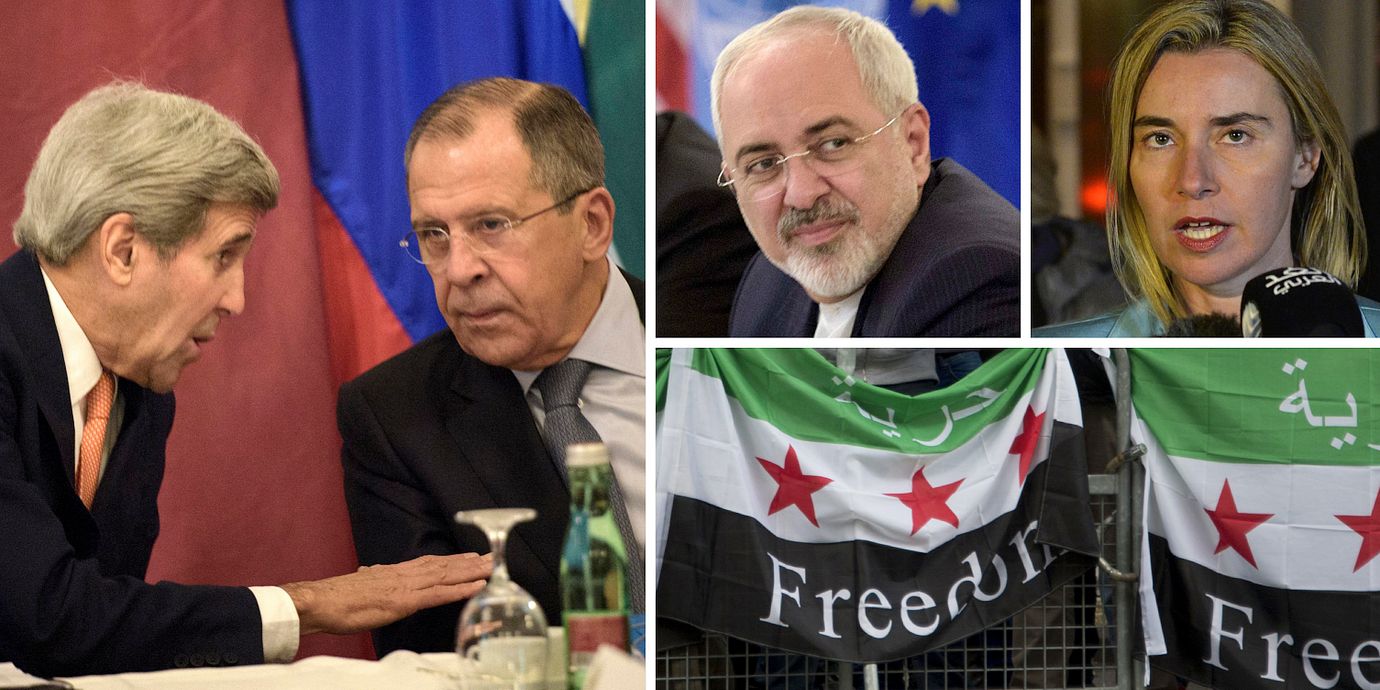
Förhandlare arbetar för vapenvila inom veckor
Deltagarna vid samtalet i Wien har presenterat en diplomatisk process som de hoppas ska leda till att Syrienkriget tar slut.
Parterna – däribland USA:s John Kerry, Rysslands Sergej Lavrov, EU:s Federica Mogherini och Irans Mohammad Javad Zarif – uppmanar FN att sammankalla oppositionen för att starta en politisk process som ska leda till en trovärdig, sekulär och inkluderande regering.
Parterna ska försöka få till stånd en vapenvila de närmaste veckorna.
– Det är dags att stoppa blodspillan och starta återuppbyggandet, sa Kerry efter mötet.
bakgrund
Inbördeskriget i Syrien
Wikipedia (en)
The Syrian Civil War (Arabic: الحرب الأهلية السورية) is an ongoing international armed conflict taking place in Syria. The unrest began in the early spring of 2011 within the context of Arab Spring protests, with nationwide protests against President Bashar al-Assad's government, whose forces responded with violent crackdowns. The conflict gradually morphed from prominent protests to an armed rebellion after months of military sieges.
The armed opposition consists of various groups that were either formed during the course of the conflict or joined from abroad. In the north-west of the country, the main opposition faction is the al-Qaeda-affiliated al-Nusra Front allied with numerous other smaller Islamist groups, some of which operate under the umbrella of the Free Syrian Army (FSA). The designation of the FSA by the West as a moderate opposition faction allows it, under the CIA-run programmes, to receive sophisticated weaponry and other military support from the U.S. and some Gulf countries that effectively increases the total fighting capacity of the Islamist rebels. In the east, the Islamic State of Iraq and the Levant (ISIL), a jihadist militant group originating from Iraq, made rapid military gains in both Syria and Iraq. ISIL eventually came into conflict with other rebels, especially with Al-Nusra, leaders of which did not want to pledge allegiance to ISIL. By July 2014, ISIL controlled a third of Syria's territory and most of its oil and gas production, thus establishing itself as the principal anti-government force. As of 2015, Qatar, Saudi Arabia and Turkey are openly backing the Army of Conquest, an umbrella rebel group that reportedly includes an al-Qaeda linked al-Nusra Front and another Salafi coalition known as Ahrar ash-Sham, and Faylaq Al-Sham, a coalition of Muslim Brotherhood-linked rebel groups. Also, in the north-east, local Kurdish militias such as the YPG have taken up arms and have fought with both rebel Islamist factions and government loyalists.
The Syrian government had mainly relied on its armed forces, but since 2014 local protection units made up of volunteers known as National Defence Force came to play a bigger role, gradually becoming the primary military force of the Syrian state. From the early stages, the Syrian government received technical, financial, military and political support from Russia, Iran and Iraq. In 2013, Iran-backed Hezbollah entered the war in support of the Syrian Army. In September 2015, Russia, Iraq, Iran and Syria set up a joint operation room (information centre) in Baghdad to coordinate their activity in Syria. On 30 September 2015, Russia started its own air campaign on the side and at the request of the government of Syria. The resultant proxy war waged between the U.S. and Russia led some commentators to characterise the situation as a "a proto-world war with nearly a dozen countries embroiled in two overlapping conflicts".
In July 2013, the Syrian government was said to be in control of approximately 30–40% of the country's territory and 60% of the Syrian population; in August 2015, the territory fully controlled by Assad’s forces was reported to have shrunk to 29,797 km2, roughly a sixth of the country. In certain regions under government control Syrian government enjoys high levels of support; according to a poll organised by British ORB-international, up to 73% percent of the population in government-controlled areas support the government effort.
A United Nations report in late 2012 described the conflict as being "overtly sectarian in nature", between mostly Alawite government forces, militias and other Shia groups fighting largely against Sunni-dominated rebel groups, although both opposition and government forces have denied it. Due to foreign involvement, this conflict has been called a proxy war. As of January 2015, the death toll had risen above 220,000 with estimates in April 2015 as high as 310,000. with the majority of casualties being Syrian soldiers and popular resistance, followed by Islamist fighters two groups together making up to 90 percent of all casualties. International organizations have accused the Syrian government, ISIL and other opposition forces of severe human rights violations, with many massacres occurring. Chemical weapons have been used many times during the conflict as well. The Syrian government is blamed by opposition for the majority of civilian casualties and war crimes, often through bombings. In addition, tens of thousands of protesters and activists have been imprisoned and there are reports of torture in state prisons. Rebels have committed various crimes and have on multiple occasions called for genocide and ethnic cleansing of Christians, Alawites, Shiite, Druze and other minorities.
The severity of the humanitarian disaster in Syria has been outlined by the UN and many international organizations. More than 7.6 million Syrians have been internally displaced, more than 5 million have fled the country to nearby countries such as Turkey, Lebanon, Jordan, Iraq, Egypt, and Kuwait, and a few hundred thousand have fled to more distant countries like Germany, Sweden and Greece and have become refugees. Millions more have been left in poor living conditions with shortages of food and drinking water.
Omni är politiskt obundna och oberoende. Vi strävar efter att ge fler perspektiv på nyheterna. Har du frågor eller synpunkter kring vår rapportering? Kontakta redaktionen