Bezos storsäljer i Amazon – vill satsa på rymdkapplöpning
Amazons grundare Jeff Bezos, världens rikaste man, har sålt en jättepost i bolaget, rapporterar Bloomberg med hänvisning till ett flaggningsmeddelande från den amerikanska motsvarigheten till Finansinspektionen.
Bezos innehav i e-handelsjätten minskade med 1,3 procent till 16,4 procent. Försäljningspriset var 1,1 miljarder dollar, motsvarande mer än 9 miljarder kronor.
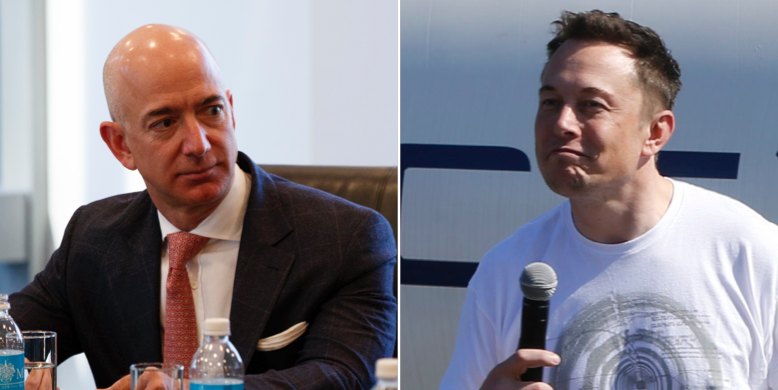
Bezos sa redan i april att han hade för avsikt att sälja aktier för 1 miljard dollar för att finansiera sitt rymdbolag Blue Origin. Företaget är en konkurrent till entreprenören Elon Musks rymdbolag Space X. Båda företagen har planer på att skicka ut privatpersoner i rymden.
bakgrund
Blue Origin
Wikipedia (en)
Blue Origin is an American privately funded aerospace manufacturer and spaceflight services company set up by Amazon.com founder Jeff Bezos with its headquarters in Kent, Washington. The company is developing technologies to enable private human access to space with the goal to dramatically lower costs and increase reliability. Blue Origin is employing an incremental approach from suborbital to orbital flight, with each developmental step building on its prior work. The company motto is "Gradatim Ferociter", Latin for "Step by Step, Ferociously". Blue Origin is developing a variety of technologies, with a focus on rocket-powered Vertical Takeoff and Vertical Landing (VTVL) vehicles for access to suborbital and orbital space. The company's name refers to the blue planet, Earth, as the point of origin.
Initially focused on sub-orbital spaceflight, the company has built and flown a testbed of its New Shepard spacecraft design at their Culberson County, Texas facility. The first developmental test flight of the New Shepard was April 29, 2015. The uncrewed vehicle flew to its planned test altitude of more than 93.5 km (307,000 ft) and achieved a top speed of Mach 3 (3,675 km/h; 2,284 mph). A second flight was performed on November 23, 2015. The vehicle went just beyond 100 km (330,000 ft) altitude reaching space for the first time, and both the space capsule and its rocket booster successfully achieved a soft landing. On January 22, 2016 Blue Origin re-flew the same New Shepard booster that launched and landed vertically in November 2015, demonstrating reuse. This time, New Shepard reached an apogee of 333,582 feet (101.7km) before both capsule and booster returned to Earth for recovery and reuse. On April 2 and June 19, 2016, the same New Shepard booster flew for its third and fourth flights, each time exceeding 330,000 ft (100 km) in altitude, before returning for successful soft landings. The first crewed test flights are planned to take place in early 2018, with the start of commercial service shortly after.
Blue Origin moved into the orbital spaceflight technology business in 2014, initially as a rocket engine supplier for others, when they entered into a contractual agreement to build a new large rocket engine, the BE-4, for major US launch system operator United Launch Alliance (ULA). ULA is also considering the BE-3, Blue Origin's smaller rocket engine used on New Shepard, for use in a new second stage—the Advanced Cryogenic Evolved Stage (ACES)—which will become the primary upper stage for ULA's Vulcan orbital launch vehicle in the 2020s. By 2015, Blue Origin had announced plans to also manufacture and fly its own orbital launch vehicle from the Florida Space Coast.
bakgrund
SpaceX
Wikipedia (en)
Space Exploration Technologies Corp., doing business as SpaceX, is an American aerospace manufacturer and space transport services company headquartered in Hawthorne, California. It was founded in 2002 by entrepreneur Elon Musk with the goal of reducing space transportation costs and enabling the colonization of Mars. SpaceX has since developed the Falcon launch vehicle family and the Dragon spacecraft family, which both currently deliver payloads into Earth orbit.
SpaceX's achievements include the first privately funded liquid-propellant rocket to reach orbit (Falcon 1 in 2008); the first privately funded company to successfully launch, orbit, and recover a spacecraft (Dragon in 2010); the first private company to send a spacecraft to the International Space Station (Dragon in 2012); the first propulsive landing for an orbital rocket (Falcon 9 in 2015); and the first reuse of an orbital rocket (Falcon 9 in 2017). As of March 2017, SpaceX has since flown ten missions to the International Space Station (ISS) under a cargo resupply contract. NASA also awarded SpaceX a further development contract in 2011 to develop and demonstrate a human-rated Dragon, which would be used to transport astronauts to the ISS and return them safely to Earth.
SpaceX announced in 2011 that they were beginning a privately funded reusable launch system technology development program. In December 2015, a first stage was flown back to a landing pad near the launch site, where it successfully accomplished a propulsive vertical landing. This was the first such achievement by a rocket for orbital spaceflight. In April 2016, with the launch of CRS-8, SpaceX successfully vertically landed a first stage on an ocean drone-ship landing platform. In May 2016, in another first, SpaceX again landed a first stage, but during a significantly more energetic geostationary transfer orbit mission. In March 2017, SpaceX became the first to successfully re-launch and land the first stage of an orbital rocket.
In September 2016, CEO Elon Musk unveiled the mission architecture of the Interplanetary Transport System program, an ambitious privately funded initiative to develop spaceflight technology for use in manned interplanetary spaceflight, and which, if demand emerges, could lead to sustainable human settlements on Mars over the long term. This is the main purpose this System was designed for. In 2017, Elon Musk announced that the company had been contracted by two private individuals to send them in a Dragon spacecraft on a free return trajectory around the Moon. Provisionally launching in 2018, this could become the first instance of lunar tourism.
Omni är politiskt obundna och oberoende. Vi strävar efter att ge fler perspektiv på nyheterna. Har du frågor eller synpunkter kring vår rapportering? Kontakta redaktionen