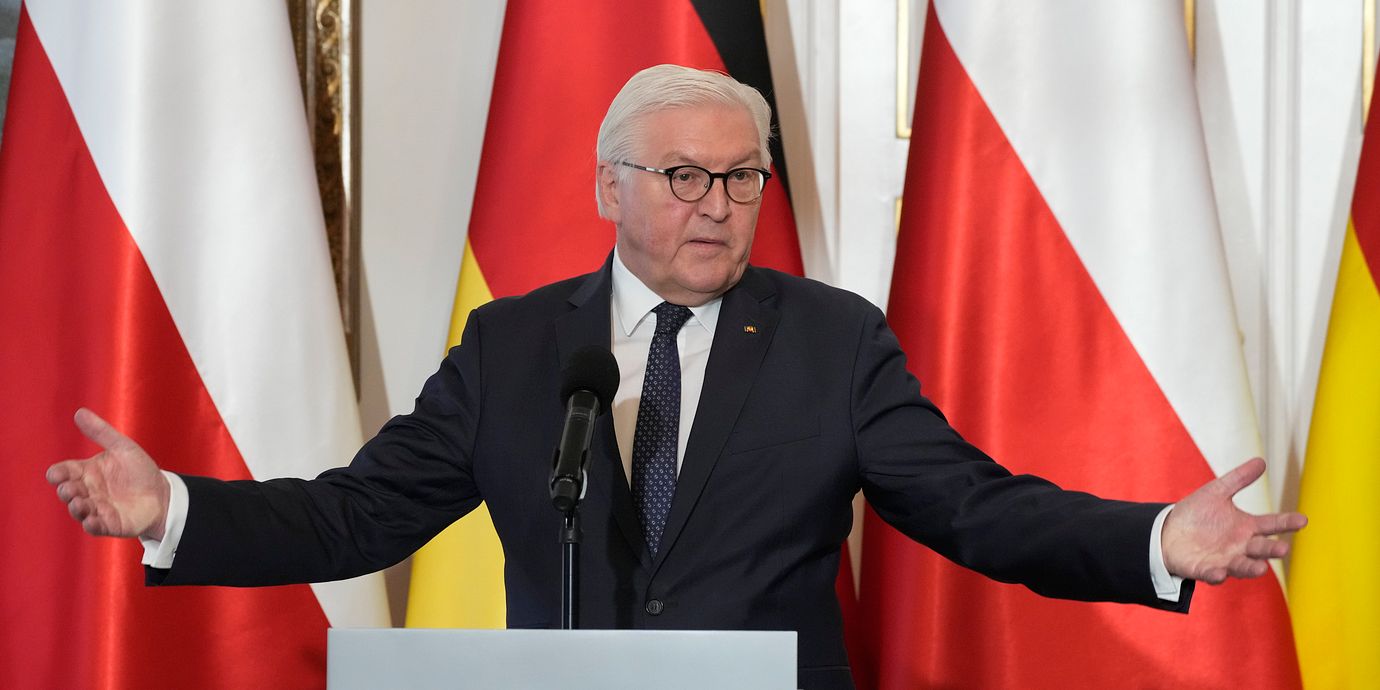
Tysklands president: Kyiv ville inte ha mig där
Den tyske presidenten Frank-Walter Steinmeier hade planerat att besöka Kyiv tillsammans med ledarna för Polen och de baltiska länderna – men Ukraina tackade nej, säger han enligt Deutsche Welle.
– Jag var redo för det. Men tydligen – måste jag erkänna – var det inte önskat i Kyiv, sade han vid ett besök i Warszawa på tisdagen.
En ukrainsk diplomat säger till den tyska tidningen Bild att de ”vet allt om Steinmeiers nära band till Ryssland”.
– Han är just nu inte välkommen i Kyiv. Vi får se om det förändras.
President Zelenskyjs rådgivare Serhij Lesjtjenko förnekar dock i en intervju att det skulle ha gått till såsom Bild rapporterar och att Zelenskyj inte nekat Steinmeier ett besök på grund av den senares påstådda ryssvänlighet.
bakgrund
Frank-Walter Steinmeier
Wikipedia (en)
Frank-Walter Steinmeier (German: [ˈfʁaŋkˌvaltɐ ˈʃtaɪnˌmaɪ.ɐ] (listen); born 5 January 1956) is a German politician and statesman serving as President of Germany since 19 March 2017. He was previously Federal Minister of Foreign Affairs from 2005 to 2009 and again from 2013 to 2017, as well as Vice Chancellor of Germany from 2007 to 2009. Steinmeier was chairman-in-office of the Organization for Security and Co-operation in Europe (OSCE) in 2016.
Steinmeier is a member of the Social Democratic Party of Germany (SPD), holds a doctorate in law and was formerly a career civil servant. He was a close aide of Gerhard Schröder when Schröder was Prime Minister of Lower Saxony during most of the 1990s, and served as Schröder's chief of staff from 1996. When Schröder became Chancellor of Germany in 1998, Steinmeier was appointed Under-Secretary of State in the German Chancellery with the responsibility for the intelligence services. From 1999 to 2005 he served as Chief of Staff of the Chancellery.
Following the 2005 federal election, Steinmeier became Foreign Minister in the first grand coalition government of Angela Merkel, and from 2007 he additionally held the office of vice chancellor. In 2008, he briefly served as acting chairman of his party. He was the SPD's candidate for chancellor in the 2009 federal election, but his party lost the election and he left the federal cabinet to become leader of the opposition. Following the 2013 federal election, he again became Minister for Foreign Affairs in Merkel's second grand coalition. In November 2016 he was announced as the candidate for President of Germany of the governing coalition, consisting of his own party and the CDU/CSU, and thus became the presumptive electee, as the coalition held a large majority in the Federal Convention. He left the cabinet on 27 January 2017. He was elected president by the Federal Convention on 12 February 2017 with 74% of the vote. On 13 February 2022, he was re-elected by the Federal Convention for a second and final term with 71% of the vote.Steinmeier belongs to the right wing of the SPD, known as reformists and moderates. As chief of staff he was a principal architect of Agenda 2010, the Schröder government's controversial reforms of the welfare state. His lenient policies toward countries such as Russia and China have earned him criticism both in Germany and internationally, and he has been criticized for prioritizing German business interests over human rights.
Omni är politiskt obundna och oberoende. Vi strävar efter att ge fler perspektiv på nyheterna. Har du frågor eller synpunkter kring vår rapportering? Kontakta redaktionen