bakgrund
FN:s generalförsamling
Wikipedia (en)
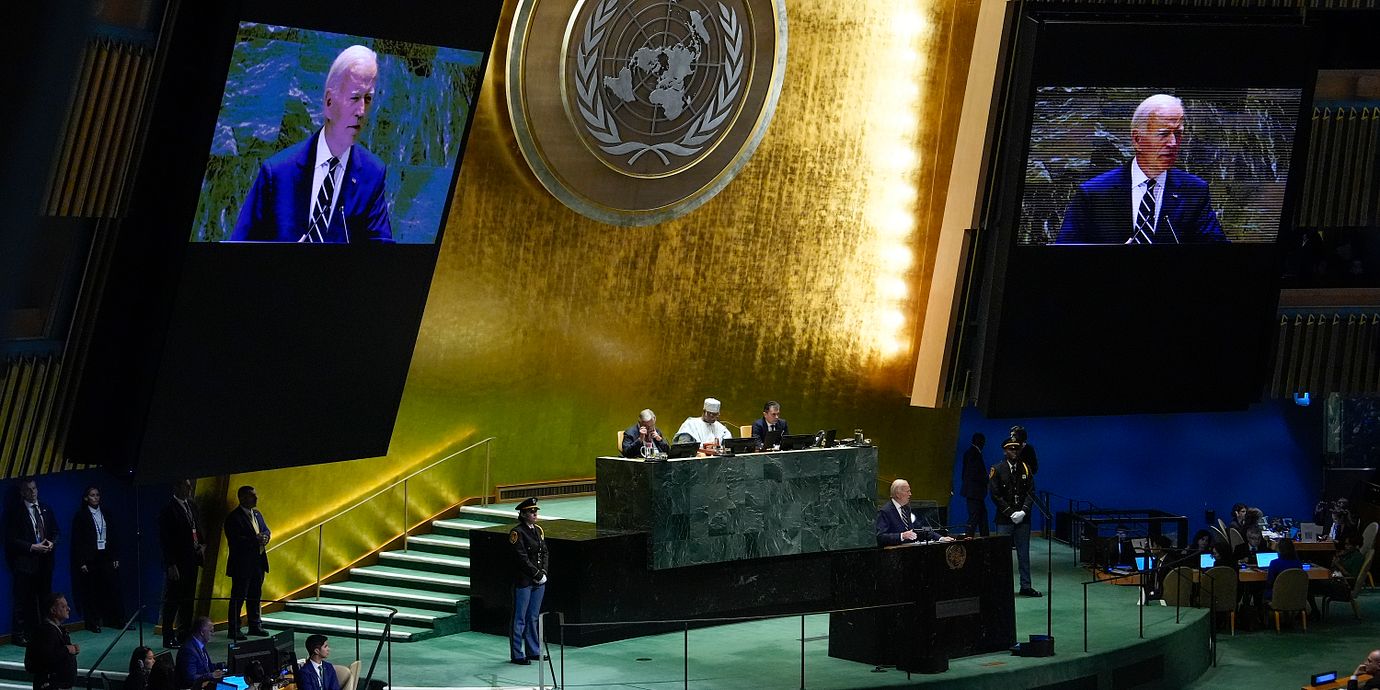
The United Nations General Assembly (UNGA or GA; French: Assemblée générale, AG) is one of the six principal organs of the United Nations (UN), serving as its main deliberative, policymaking, and representative organ. Currently in its 78th session, its powers, composition, functions, and procedures are set out in Chapter IV of the United Nations Charter.
The UNGA is responsible for the UN budget, appointing the non-permanent members to the Security Council, appointing the UN secretary-general, receiving reports from other parts of the UN system, and making recommendations through resolutions. It also establishes numerous subsidiary organs to advance or assist in its broad mandate. The UNGA is the only UN organ where all member states have equal representation.
The General Assembly meets under its President or the UN secretary-general in annual sessions at the General Assembly Building, within the UN headquarters in New York City. The primary phase of these meetings generally runs from September through part of January until all issues are addressed, which is often before the next session starts. It can also reconvene for special and emergency special sessions. The first session was convened on 10 January 1946 in the Methodist Central Hall in London and included representatives of the 51 founding nations.
Most questions are decided in the General Assembly by a simple majority. Each member country has one vote. Voting on certain important questions—namely recommendations on peace and security; budgetary concerns; and the election, admission, suspension, or expulsion of members—is by a two-thirds majority of those present and voting. Apart from the approval of budgetary matters, including the adoption of a scale of assessment, Assembly resolutions are not binding on the members. The Assembly may make recommendations on any matters within the scope of the UN, except matters of peace and security under the Security Council's consideration.
During the 1980s, the Assembly became a forum for "North-South dialogue" between industrialized nations and developing countries on a range of international issues. These issues came to the fore because of the phenomenal growth and changing makeup of the UN membership. In 1945, the UN had 51 members, which by the 21st century nearly quadrupled to 193, of which more than two-thirds are developing countries. Because of their numbers, developing countries are often able to determine the agenda of the Assembly (using coordinating groups like the G77), the character of its debates, and the nature of its decisions. For many developing countries, the UN is the source of much of their diplomatic influence and the principal outlet for their foreign relations initiatives.
Although, the resolutions passed by the General Assembly do not have the binding forces over the member nations (apart from budgetary measures), pursuant to its Uniting for Peace resolution of November 1950 (resolution 377 (V)), the Assembly may also take action if the Security Council fails to act, owing to the negative vote of a permanent member, in a case where there appears to be a threat to the peace, breach of the peace or act of aggression. The Assembly can consider the matter immediately with a view to making recommendations to Members for collective measures to maintain or restore international peace and security.