Hem
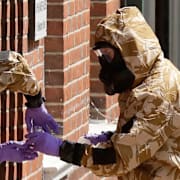
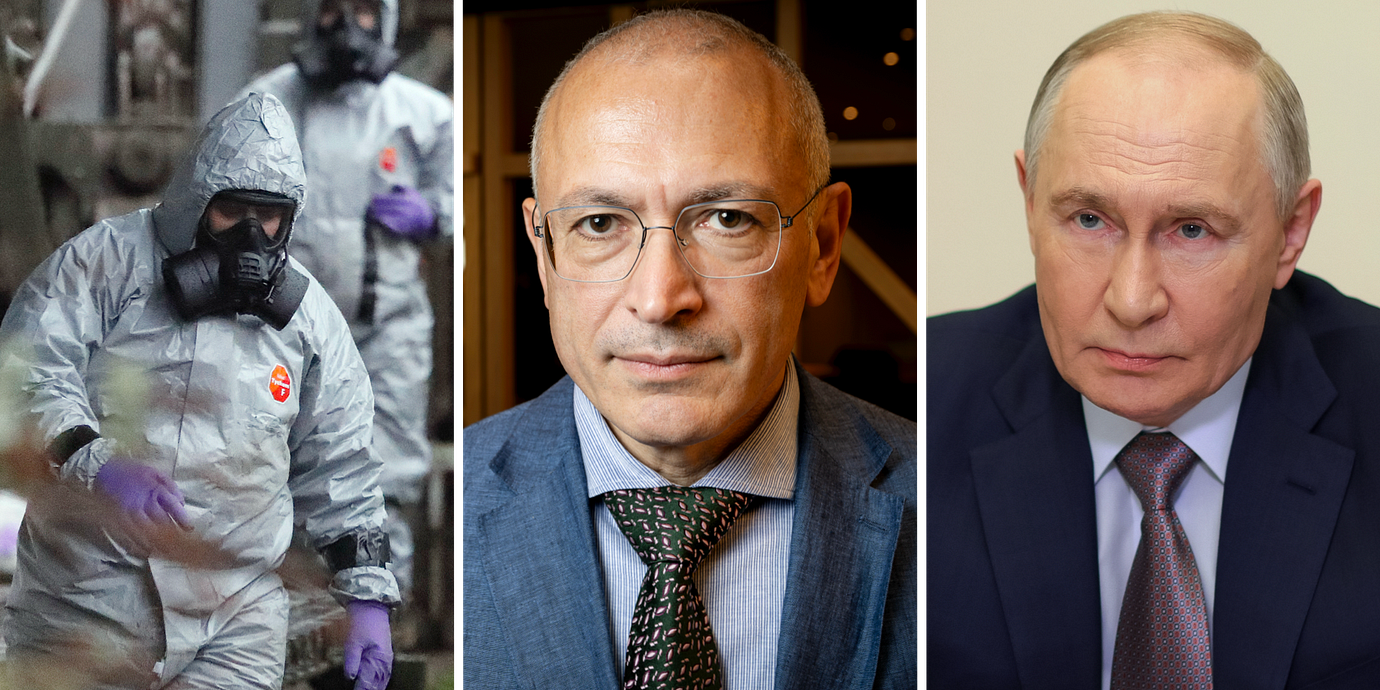
Utredare i skyddsutrustning i Salisbury 2018. Michail Chodorkovskij och Valdimir Putin. (AP/SVD/TT)

Exiloligarken: Ny Salisbury-attack kan vara på väg

Den ryske exiloligarken Michail Chodorkovskij menar att Rysslands president Vladimir Putin sannolikt kommer att försöka orkestrera en ny Salisbury-liknande attack i Storbritannien. Det säger han i en intervju med The Guardian.

Attacken i Salisbury inträffade 2018, då Sergej och Julia Skripal misstänktes ha förgiftats med nervgiftet novitjok. Sergej Skripal var en dubbelagent med kopplingar till både Ryssland och Storbritannien.

Syftet med en liknande attack skulle vara att ”undanröja vissa personer och skapa en känsla av sårbarhet i väst”, säger Chodorkovskij.

– Kreml är inte dumma, de är ganska kreativa. De kommer att försöka hitta nya sätt att agera. Det som står klart är att det kommer att bli någon form av påtryckningar, och att de kommer att ta en liknande form som i Salisbury.

Enligt Chodorkovskij har Putin pekat ut Storbritannien som Europas främsta fiende. Han menar att den brittiska regeringen därför måste vidta mer offensiva åtgärder mot Kreml för att motverka ett sådant scenario.

Förgiftningarna i Storbritannien – det gäller saken

Den 4 mars 2018 hittades ex-spionen Sergej Skripal och hans dotter Julia medvetslösa i Salisbury, Storbritannien, efter att ha förgiftats med ett nervgift.

Brittiska myndigheter anklagade två ryska GRU-officerare för attacken. Ryssland har förnekat all inblandning.

Händelsen ledde till en diplomatisk kris med massutvisningar av diplomater mellan Storbritannien, Ryssland, USA och flera EU-länder samt införande av sanktioner.

I juli 2018 dog en brittisk kvinna, Dawn Sturgess, efter att ha kommit i kontakt med Novitjok i en parfymflaska. Polisen kopplade fallet till Skripal-attacken.

Internationella utredningar och rättsprocesser har fortsatt, och 2021 åtalades en tredje rysk GRU-agent för inblandning i förgiftningen av Skripal.


bakgrund
 
Salisburyattacken
Wikipedia (en)
The poisoning of Sergei and Yulia Skripal, also known as the Salisbury poisoning, was a failed assassination attempt to poison Sergei Skripal, a former Russian military officer and double agent for the British intelligence agencies in the city of Salisbury, England on 4 March 2018. Sergei and his daughter, Yulia Skripal, were poisoned by means of a Novichok nerve agent. Both spent several weeks in hospital in a critical condition, before being discharged. A police officer, Nick Bailey, was also taken into intensive care after attending the incident, and was later discharged. The British government accused Russia of attempted murder and announced a series of punitive measures against Russia, including the expulsion of diplomats. The UK's official assessment of the incident was supported by 28 other countries which responded similarly. Altogether, an unprecedented 153 Russian diplomats were expelled by the end of March 2018. Russia denied the accusations, expelled foreign diplomats in retaliation for the expulsion of its own diplomats, and accused Britain of the poisoning. On 30 June 2018, a similar poisoning of two British nationals in Amesbury, 11 km (7 mi) north of Salisbury, involved the same nerve agent. Charlie Rowley found a perfume bottle, later discovered to contain the agent, in a litter bin somewhere in Salisbury and gave it to Dawn Sturgess, who sprayed it on her wrist. Sturgess fell ill within 15 minutes and died on 8 July, but Rowley, who had also come into contact with the poison, survived after treatment. British police believe this incident was not a targeted attack, but a result of the way the nerve agent was disposed of after the poisoning in Salisbury. A public inquiry was launched into the circumstances of Sturgess's death. On 5 September 2018, British authorities identified two Russian nationals, using the names Alexander Petrov and Ruslan Boshirov, as suspected of the Skripals' poisoning, and alleged that they were active officers in Russian military intelligence. Later, investigative website Bellingcat stated that it had positively identified Ruslan Boshirov as being the highly decorated GRU Colonel Anatoliy Chepiga, that Alexander Petrov was Alexander Mishkin, also of the GRU, and that a third GRU officer present in the UK at the time was identified as Denis Vyacheslavovich Sergeev, believed to hold the rank of major general in the GRU. The pattern of his communications while in the UK indicates that he liaised with superior officers in Moscow. The attempted assassination and subsequent agent exposures was an embarrassment for Putin and for Russia's spying organisation. It was allegedly organised by the secret Unit 29155 of the Russian GRU, under the command of Major General Andrey Averyanov. On 27 November 2019, the Organisation for the Prohibition of Chemical Weapons (OPCW) added Novichok, the Soviet-era nerve agent used in the attack, to its list of banned substances.
bakgrund
 
Michail Chodorkovskij
Wikipedia (en)
Mikhail Borisovich Khodorkovsky (Russian: Михаил Борисович Ходорковский, IPA: [mʲɪxɐˈil xədɐrˈkofskʲɪj]; born 26 June 1963), sometimes known by his initials MBK, is an exiled Russian businessman, oligarch, and opposition activist, now residing in London. In 2003, Khodorkovsky was believed to be the wealthiest man in Russia, with a fortune estimated to be worth $15 billion, and was ranked 16th on Forbes list of billionaires. He had worked his way up the Komsomol apparatus, during the Soviet years, and started several businesses during the period of glasnost and perestroika in the late 1980s. In 1989, he became Chairman of the Board of Bank Menatep, which he founded. After the dissolution of the Soviet Union, in the mid-1990s, he accumulated considerable wealth by obtaining control of a number of Siberian oil fields unified under the name Yukos, one of the major companies to emerge from the privatization of state assets during the 1990s (a scheme known as "Loans for Shares"). In 2001, Khodorkovsky founded Open Russia, a reform-minded organization intending to "build and strengthen civil society" in the country. In October 2003, he was arrested by Russian authorities and charged with fraud. The government of President Vladimir Putin then froze shares of Yukos shortly thereafter on tax charges. Putin's government took further actions against Yukos, leading to a collapse of the company's share price and the evaporation of much of Khodorkovsky's wealth. In May 2005, he was found guilty and sentenced to nine years in prison. In December 2010, while he was still serving his sentence, Khodorkovsky and his business partner Platon Lebedev were further charged with and found guilty of embezzlement and money laundering. Khodorkovsky's prison sentence was extended to 2014. After former German minister for foreign affairs Hans-Dietrich Genscher lobbied for his release, Putin pardoned Khodorkovsky, releasing him from jail on 20 December 2013. There was widespread concern internationally that the trials and sentencing were politically motivated. The trial was criticized abroad for the lack of due process. Khodorkovsky lodged several applications with the European Court of Human Rights, seeking redress for alleged violations by Russia of his human rights. In response to his first application, which concerned events from 2003 to 2005, the court found that several violations were committed by the Russian authorities in their treatment of Khodorkovsky. Despite these findings, the court ultimately ruled that the trial was not politically motivated, but rather "that the charges against him were grounded in 'reasonable suspicion'". He was considered to be a prisoner of conscience by Amnesty International. On being pardoned by Putin and released from prison at the end of 2013, Khodorkovsky immediately left Russia and was granted residency in Switzerland. At the end of 2013, his personal estate was believed to be worth, as a rough estimate, $100–250 million. At the end of 2014, he was said to be worth about $500 million. In 2015, he moved to London. In December 2016, the Dublin District Court unfroze $100m of Khodorkovsky's assets that had been held in the Republic of Ireland. In 2014, Khodorkovsky re-launched Open Russia to promote several reforms to Russian civil society, including free and fair elections, political education, protection of journalists and activists, endorsing the rule of law, and ensuring media independence. He was described by The Economist as "the Kremlin's leading critic-in-exile".
Omni är politiskt obundna och oberoende. Vi strävar efter att ge fler perspektiv på nyheterna. Har du frågor eller synpunkter kring vår rapportering? Kontakta redaktionen