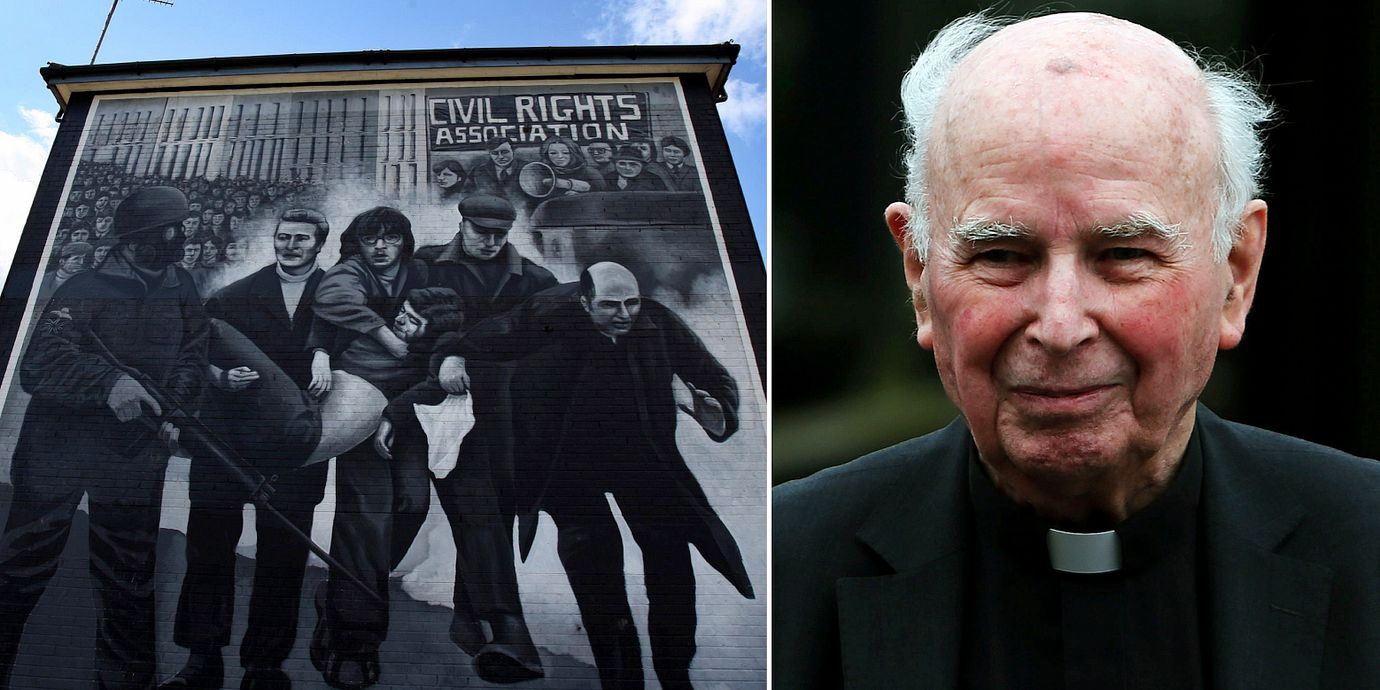
Irländsk präst som blev fredsikon har dött
Prästen Edward Daly, känd för sin insats vid den ”blodiga söndagen” i Nordirland, har dött vid 82 års ålder.
Det var söndagen den 30 januari 1972 som brittiska soldater sköt mot en grupp katoliker under en protestmarsch i staden Derry, varpå 13 människor dog. Numera ikoniska tv-bilder visar hur Edward Daly ledde skadade personer förbi de brittiska soldaterna, viftandes med en vit näsduk ovanför huvudet.
bakgrund
Edward Daly
Wikipedia (en)
Edward Daly, D.D. (5 December 1933 – 8 August 2016) was an Irish Roman Catholic priest and author. He served as the Bishop of Derry from 1974 to 1993. Daly took part in several civil rights marches and events during the Troubles; he appears in the iconic photograph from Bloody Sunday, waving a blood-stained white handkerchief as he escorts a group carrying a mortally-wounded man after British troops opened fire on demonstrators.
bakgrund
”Blodiga söndagen” trappade upp konflikten på Nordirland
Wikipedia (en)
Bloody Sunday – sometimes called the Bogside Massacre – was an incident on 30 January 1972 in the Bogside area of Derry, Northern Ireland. British soldiers shot 26 unarmed civilians during a protest march against internment. Fourteen people died: thirteen were killed outright, while the death of another man four months later was attributed to his injuries. Many of the victims were shot while fleeing from the soldiers and some were shot while trying to help the wounded. Other protesters were injured by rubber bullets or batons, and two were run down by army vehicles. The march had been organised by the Northern Ireland Civil Rights Association and the Northern Resistance Movement. The soldiers involved were members of the 1st Battalion, Parachute Regiment, also known as "1 Para".
Two investigations have been held by the British government. The Widgery Tribunal, held in the immediate aftermath of the incident, largely cleared the soldiers and British authorities of blame. It described the soldiers' shooting as "bordering on the reckless", but accepted their claims that they shot at gunmen and bomb-throwers. The report was widely criticised as a "whitewash". The Saville Inquiry, chaired by Lord Saville of Newdigate, was established in 1998 to reinvestigate the incident. Following a 12-year inquiry, Saville's report was made public in 2010 and concluded that the killings were both "unjustified" and "unjustifiable". It found that all of those shot were unarmed, that none were posing a serious threat, that no bombs were thrown, and that soldiers "knowingly put forward false accounts" to justify their firing. On the publication of the report, British prime minister David Cameron made a formal apology on behalf of the United Kingdom. Following this, police began a murder investigation into the killings.
Bloody Sunday was one of the most significant events of "the Troubles" because a large number of civilian citizens were killed, by forces of the state, in full view of the public and the press. It was the highest number of people killed in a single shooting incident during the conflict. Bloody Sunday increased Catholic and Irish nationalist hostility towards the British Army and exacerbated the conflict. Support for the Provisional Irish Republican Army (IRA) rose and there was a surge of recruitment into the organisation, especially locally.
Omni är politiskt obundna och oberoende. Vi strävar efter att ge fler perspektiv på nyheterna. Har du frågor eller synpunkter kring vår rapportering? Kontakta redaktionen