Kina bygger ut sin järnväg för 4 600 miljarder
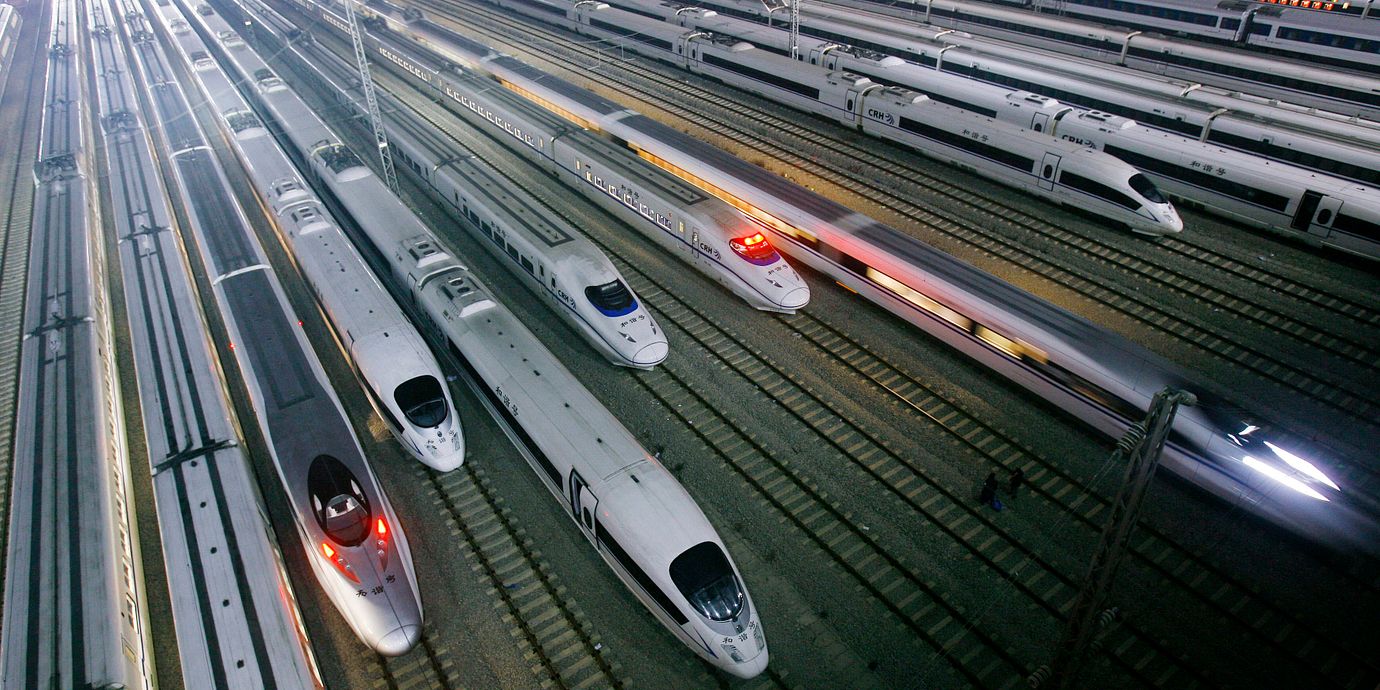
Kinas regering vill investera motsvarande 4 600 miljarder kronor till 2020 för att bygga ut landets järnväg för höghastighetståg, enligt ett förslag som publicerades av informationskontoret under torsdagen. Dessutom vill man bygga ut tågnäten kring tätorter med 3 000 kilometer.
Investeringarna i infrastruktur beskrivs av Bloomberg som ett sätt att lyfta Kinas inbromsande tillväxt och nyheten fick flera bolag att lyfta på Hongkongbörsen, däribland China Railway Construction.
När Kina för ett knappt decennium gjorde stora investeringar i järnvägen berördes bland andra Hexagon, SKF och ABB, enligt nyhetsbyrån Direkt.
bakgrund
Höghastighetståg i Kina
Wikipedia (en)
High-speed rail (HSR) in China is the longest HSR system in the world extending to 28 of the country's 33 provincial-level entities. The network consists of newly built passenger-dedicated lines (PDLs) and intercity lines along with upgraded mixed passenger and freight lines. The newly built PDL lines without including intercity and upgraded passenger and freight lines currently account for 20,000 km (12,000 mi) of service routes, a length that is more than the rest of the world's high-speed rail tracks combined. The expansion of the PDL network and other high speed lines is ongoing with the PDL routes alone reaching a planned 38,000 km (24,000 mi) in 2025.
High-speed rail service in China was introduced on April 18, 2007 and has become immensely popular with an annual ridership of over 1.1 billion in 2015, making the Chinese HSR network the most heavily used in the world. Notable lines include the world's longest line, the 2,298 km (1,428 mi) Beijing–Guangzhou High-Speed Railway and the Shanghai Maglev, the world's first high-speed commercial magnetic levitation (maglev) line and the only non-conventional track line of the network.
Nearly all high-speed rail lines and rolling stock are owned and operated by the China Railway Corporation, the state enterprise formerly known as the Railway Ministry, which has overseen the HSR building boom with generous funding from the Chinese government's economic stimulus program. The pace of high-speed rail expansion slowed for a period in 2011 after the removal of Chinese Railways Minister Liu Zhijun for corruption and a fatal high-speed railway accident near Wenzhou, but has since rebounded. Though the system as a whole is considered successful, concerns about HSR safety, high ticket prices, low ridership, financial sustainability and environmental impact of high-speed rail continue to exist for several projects.
China's early high-speed trains were imported or built under technology transfer agreements with foreign train-makers including Alstom, Siemens, Bombardier and Kawasaki Heavy Industries. Chinese engineers then re-designed internal train components and built indigenous trains. Today, most of China's high speed rail trains are thus made in China by the CRRC.
Omni är politiskt obundna och oberoende. Vi strävar efter att ge fler perspektiv på nyheterna. Har du frågor eller synpunkter kring vår rapportering? Kontakta redaktionen