Lövin: SD uppvisar en horribel faktaresistens
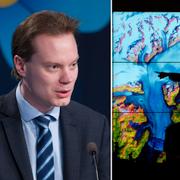
Sverigedemokraterna vill jämfört med regeringen skära ned på anslagen för klimat och miljö med nästan 8 miljarder på fyra år, skriver Aftonbladet. Det framkommer i en motion som riksdagsledamoten Martin Kinnunen (SD) står bakom. I en intervju med Aftonbladet säger Kinnunen att man inte kan dra några säkra slutsater om i vilken grad människan påverkat på klimatet.
Klimatminister Isabella Lövin (MP) är mycket kritisk till Kinnunens uttalande. Hon säger att det är en ”horribel faktaresistens” som partiet står för.
– Det är oerhört oroväckande att man nu börjar prata om att det finns osäkerheter och ifrågasätter forskare. Och det visar varför det skulle vara så farligt om SD skulle styra över Sveriges myndigheter, säger hon.
bakgrund
Global uppvärmning
Wikipedia (en)
Global warming and climate change are terms for the observed century-scale rise in the average temperature of the Earth's climate system and its related effects. Multiple lines of scientific evidence show that the climate system is warming. Although the increase of near-surface atmospheric temperature is the measure of global warming often reported in the popular press, most of the additional energy stored in the climate system since 1970 has gone into the oceans. The rest has melted ice and warmed the continents and atmosphere. Many of the observed changes since the 1950s are unprecedented over tens to thousands of years.
Scientific understanding of global warming is increasing. The Intergovernmental Panel on Climate Change (IPCC) reported in 2014 that scientists were more than 95% certain that global warming is mostly being caused by human (anthropogenic) activities, mainly increasing concentrations of greenhouse gases such as methane and carbon dioxide (CO2). Human activities have led to carbon dioxide concentrations above levels not seen in hundreds of thousands of years. Methane and other, often much more potent, greenhouse gases are also rising along with CO2. Currently, about half of the carbon dioxide released from the burning of fossil fuels remains in the atmosphere. The rest is absorbed by vegetation and the oceans. Climate model projections summarized in the report indicated that during the 21st century the global surface temperature is likely to rise a further 0.3 to 1.7 °C (0.5 to 3.1 °F) for their lowest emissions scenario and 2.6 to 4.8 °C (4.7 to 8.6 °F) for the highest emissions scenario. These findings have been recognized by the national science academies of the major industrialized nations and are not disputed by any scientific body of national or international standing.
Future climate change and associated impacts will differ from region to region around the globe. Anticipated effects include warming global temperature, rising sea levels, changing precipitation, and expansion of deserts in the subtropics. Warming is expected to be greater over land than over the oceans and greatest in the Arctic, with the continuing retreat of glaciers, permafrost and sea ice. Other likely changes include more frequent extreme weather events including heat waves, droughts, heavy rainfall with floods and heavy snowfall; ocean acidification; and species extinctions due to shifting temperature regimes. Effects significant to humans include the threat to food security from decreasing crop yields and the abandonment of populated areas due to rising sea levels. Because the climate system has a large "inertia" and greenhouse gases will stay in the atmosphere for a long time, many of these effects will not only exist for decades or centuries, but will persist for tens of thousands of years.
Possible societal responses to global warming include mitigation by emissions reduction, adaptation to its effects, building systems resilient to its effects, and possible future climate engineering. Most countries are parties to the United Nations Framework Convention on Climate Change (UNFCCC), whose ultimate objective is to prevent dangerous anthropogenic climate change. Parties to the UNFCCC have agreed that deep cuts in emissions are required and that global warming should be limited to well below 2.0 °C (3.6 °F) relative to pre-industrial levels, with efforts made to limit warming to 1.5 °C (2.7 °F).
Public reactions to global warming and concern about its effects are also increasing. A global 2015 Pew Research Center report showed a median of 54% consider it "a very serious problem". There are significant regional differences, with Americans and Chinese (whose economies are responsible for the greatest annual CO2 emissions) among the least concerned.
Omni är politiskt obundna och oberoende. Vi strävar efter att ge fler perspektiv på nyheterna. Har du frågor eller synpunkter kring vår rapportering? Kontakta redaktionen