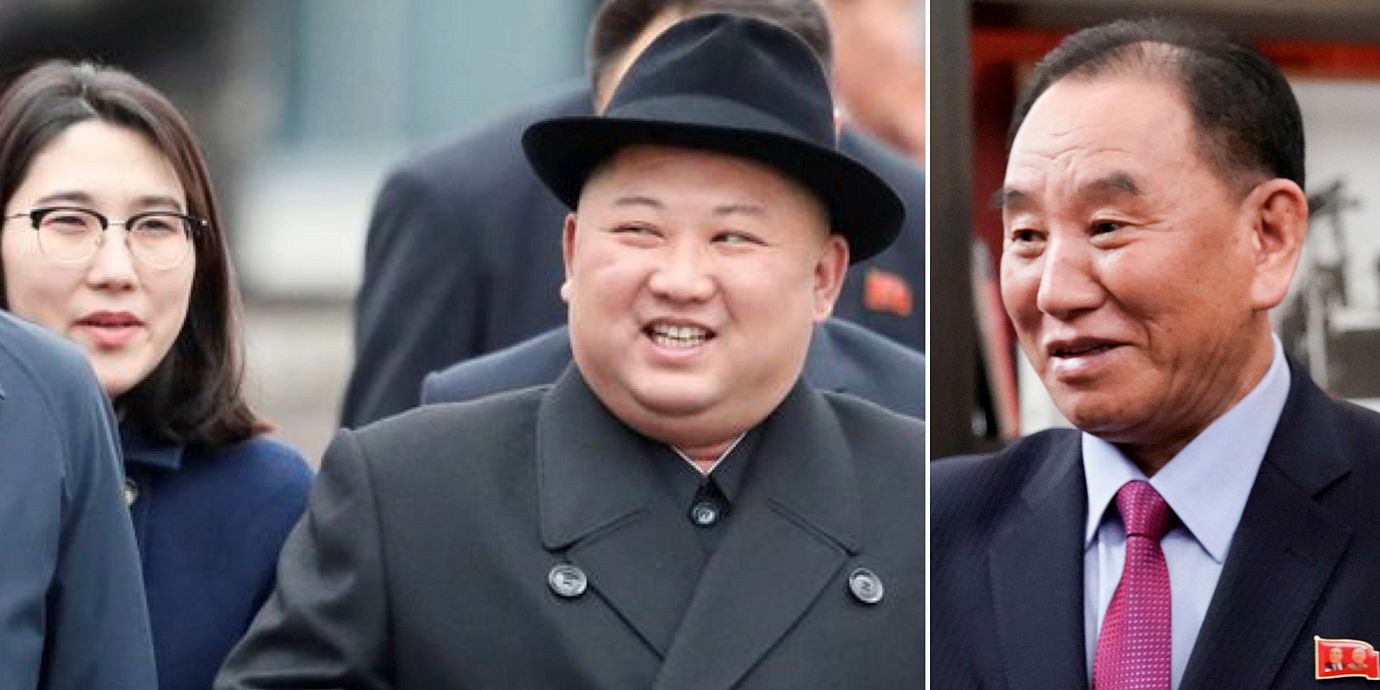
Efter fiaskot i Hanoi: Kim nobbar sin högra hand
Kim Jong-Un har degraderat sin närmaste medarbetare Kim Yong-Chol inför torsdagens möte med Vladimir Putin, rapporterar Reuters med hänvisning till sydkoreanska medier.
Efter det misslyckade mötet mellan den nordkoreanske ledaren och Donald Trump i Hanoi i februari ser Kim Jong-Un ut att ha satt rådgivaren på läktaren. Kim Yong-Chol är en av de mest hängivna kärnvapenförespråkarna, och hans frånvaro kan vara ett positivt tecken inför framtida samtal, säger den sydkoreanske forskaren Cheong Seong-Chang.
– Den orealistiska förhandlingsstrategin som Kim hade i Hanoi visade att han inte kunde agera rationellt på grund av ”hökarnas” påverkan, säger han.
bakgrund
Relationen mellan Nordkorea och Ryssland
Wikipedia (en)
Diplomatic relations between North Korea (Democratic People's Republic of Korea, DPRK) and the Soviet Union (Union of Soviet Socialist Republics, USSR, the predecessor state to the Russian Federation) were first established on October 12, 1948, shortly after the Democratic People's Republic of Korea was proclaimed. During the Korean War, the Korean People's Army was supported by the Soviet military forces. North Korea was founded as part of the Communist bloc, and received major Russian support. China and the Soviet Union competed for influence in North Korea during the Sino-Soviet split in the 1960s, as North Korea tried to maintain good relations with both countries.Relations between the two countries continued after the fall of the Soviet Union. The relationship gained some importance again after Vladimir Putin was elected President of Russia in 2000. Kim Jong-un also accepted an invitation to visit Russia in mid-2015. The two states share a border along the lower Tumen River (Туманная), which is 17 kilometers (11 mi) long and was formed in 1860 when the Tsar Alexander II acquired territory ceded from China in the Convention of Peking.
Favorable perceptions of North Korea in Russia are gradually declining, with only 34% of Russians viewing North Korea as a friendly nation and 60% of Russians believing that North Korea's nuclear arms pose a threat to other countries; only 8% of Russians favor supporting North Korea in a potential conflict. According to a 2014 BBC World Service Poll, 19% of Russians view North Korea's influence positively, with 37% expressing a negative view.
Omni är politiskt obundna och oberoende. Vi strävar efter att ge fler perspektiv på nyheterna. Har du frågor eller synpunkter kring vår rapportering? Kontakta redaktionen