Merz pekar ut ny president – första kvinnan på posten
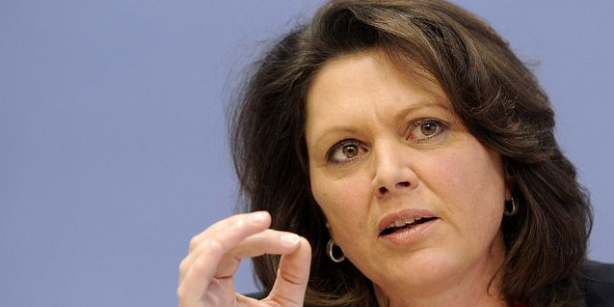
Tysklands förbundskansler Friedrich Merz kommer att nominera kristdemokraten Ilse Aigner till att bli landets nästa förbundspresident, rapporterar tyska medier.
61-åriga Aigner tillhör CSU, det bayerska systerpartiet till Merz CDU. Hon är i dagsläget talman i Bayerns delstatsparlament.
Skulle Aigner bli vald till president blir hon både den första kvinnan på ämbetet, och den första från CSU, skriver Die Zeit.
För att bli vald måste Ilse Aigner få stöd från förbundsförsamlingen, som består av ledamöter från både förbundsdagen och delstaterna.
Den tyska förbundspresidenten är landets statschef, även om rollen till stor del är ceremoniell.
Sedan 2017 är socialdemokraten Frank-Walter Steinmeier Tysklands president.
bakgrund
CSU
Wikipedia (en)
The Christian Social Union in Bavaria (German: , CSU) is a Christian democratic and conservative political party in Germany. Having a regionalist identity, the CSU operates only in Bavaria while its larger counterpart, the Christian Democratic Union (CDU), operates in the other 15 states of Germany. The CSU is considered more conservative than the CDU. Founded in 1945, the CSU is considered the de facto successor of the Weimar-era Catholic Bavarian People's Party.
At the federal level, the CSU forms a common faction in the Bundestag with the CDU which is frequently referred to as the Union Faction (die Unionsfraktion) or simply CDU/CSU. The CSU has had 44 seats in the Bundestag since the 2025 federal election, making it currently the sixth largest of the seven parties represented and the largest parliamentary faction as part of CDU/CSU with 208 seats. The CSU is a member of the European People's Party and the International Democracy Union.
Party leader Markus Söder serves as Minister-President of Bavaria, a position that CSU representatives have held from 1946 to 1954 and again since 1957. From 1962 to 2008 and from 2013 to 2018, the CSU had the absolute majority in the Bavarian Landtag.
bakgrund
Tysklands president
Wikipedia (en)
The president of Germany, officially titled the federal president of the Federal Republic of Germany (German: Bundespräsident der Bundesrepublik Deutschland), is the head of state of Germany. The current officeholder is Frank-Walter Steinmeier, who was elected on 12 February 2017 and re-elected on 13 February 2022. He is currently serving his second five-year-term, which began on 19 March 2022.
Under the 1949 constitution (Basic Law) Germany has a parliamentary system of government in which the chancellor is the head of government (the title prime minister is most common for this role in other countries). The president has a ceremonial role as figurehead, but also has the right and duty to act politically. They can give direction to general political and societal debates and have some important reserve powers in case of political instability (such as those provided for by Article 81 of the Basic Law). The president also holds the prerogative to grant pardons on behalf of the federation. The German presidents, who can be elected to two consecutive five-year terms, have wide discretion about how they exercise their official duties.
Under Article 59(1) of the Basic Law, the president represents the Federal Republic of Germany in matters of international law, concludes treaties with foreign states on its behalf and accredits diplomats. Furthermore, all federal laws must be signed by the president before they can come into effect; presidents may veto a law if they believe it to violate the constitution.
The president's actions and public appearances represent the state itself, its existence, legitimacy, and unity. The president enjoys a higher ranking at official functions than the chancellor. The president's role is integrative and includes the control function of upholding the law and the constitution. It is a matter of political tradition – not legal restrictions – that the president generally does not comment routinely on issues in the news, particularly when there is some controversy among the political parties. This distance from day-to-day politics and daily governmental issues allows the president to be a source of clarification, to influence public debate, voice criticism, offer suggestions, and make proposals. In order to exercise this power, they traditionally act above party politics.
bakgrund
Frank-Walter Steinmeier
Wikipedia (en)
Frank-Walter Steinmeier (German: [ˈfʁaŋkˌvaltɐ ˈʃtaɪnˌmaɪ.ɐ] ; born 5 January 1956) is a German politician who has served as President of Germany since 2017. He was previously Minister for Foreign Affairs from 2005 to 2009 and again from 2013 to 2017, as well as Vice-Chancellor of Germany from 2007 to 2009. Steinmeier was Chairman-in-Office of the Organization for Security and Co-operation in Europe (OSCE) in 2016.
Steinmeier is a member of the Social Democratic Party of Germany (SPD), holds a doctorate in law, and was formerly a career civil servant. He was a close aide of Gerhard Schröder when Schröder was Minister-President of Lower Saxony during most of the 1990s, and served as Schröder's chief of staff from 1996. When Schröder became Chancellor of Germany in 1998, Steinmeier was appointed Under-Secretary of State in the German Chancellery with responsibility for the intelligence services. From 1999 to 2005, he served as Chief of Staff of the Chancellery.
Following the 2005 federal election, Steinmeier became Foreign Minister in the first grand coalition government of Angela Merkel, and from 2007 he additionally held the office of vice chancellor. In 2008, he briefly served as acting chairman of his party. He was the SPD's candidate for Chancellor in the 2009 federal election, but his party lost the election and he left the federal cabinet to become leader of the opposition. Following the 2013 federal election, he again became Minister for Foreign Affairs in Merkel's second grand coalition. In November 2016, the governing CDU/CSU-SPD coalition, which held a large majority in the Federal Convention, nominated him as candidate for President of Germany. He left the cabinet on 27 January 2017. He was elected president by the Federal Convention on 12 February 2017 with 74% of the vote. On 13 February 2022, he was re-elected by the Federal Convention for a second and final term with 78% of the vote.
Steinmeier is known as a reform-minded moderate within the SPD. As chief of staff, he was a principal architect of Agenda 2010, the Schröder government's reforms of the welfare state. His lenient, Realpolitik-driven policies toward authoritarian nations like Russia and China have drawn criticism both within Germany and across the liberal democratic world. Furthermore, critics have labeled him a corporatist for prioritizing German business interests over human rights.
Omni är politiskt obundna och oberoende. Vi strävar efter att ge fler perspektiv på nyheterna. Har du frågor eller synpunkter kring vår rapportering? Kontakta redaktionen