VW ser inte Tesla som hot: ”Äpplen och päron”
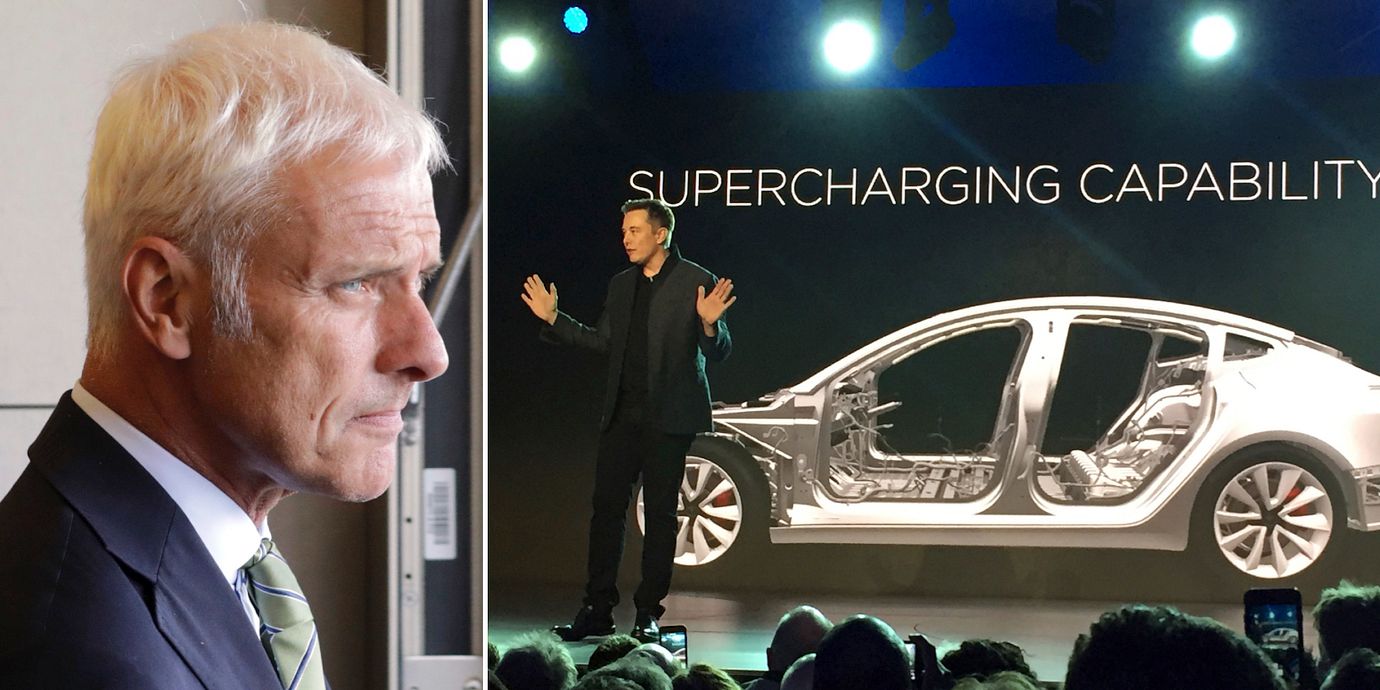
Volkswagen ser inte Tesla som ett hot på elbilsmarknaden. Det säger vd:n Matthias Müller i samband med bilmässan i Frankfurt.
– Vi kan inte jämföra äpplen med päron. Tesla är ett företag som säljer mindre än 100 000 enheter och vi säljer 10 miljoner. För närvarande bränner Tesla ett tresiffrigt miljonbelopp och vi har resultat på mellan 12 och 13 miljarder euro per år, så jag tror att vi måste vara realistiska här.
I går meddelade Volkswagen att man ska satsa 188 miljarder kronor för att kunna erbjuda en eldriven fordonsflotta 2030.
bakgrund
WLTP
Wikipedia (en)
The Worldwide harmonized Light vehicles Test Procedure (WLTP) defines a global harmonized standard for determining the levels of pollutants and CO2 emissions, fuel or energy consumption, and electric range from light-duty vehicles (passenger cars and light commercial vans).
Experts from the European Union, Japan, and India under guidelines of UNECE World Forum for Harmonization of Vehicle Regulations, are developing it, with final version expected for October 2015.
bakgrund
Volkswagens utsläppsskandal
Wikipedia (en)
The Volkswagen emissions scandal (also called "emissionsgate" or "dieselgate") started on 18 September 2015, when the United States Environmental Protection Agency (EPA) issued a notice of violation of the Clean Air Act to German automaker Volkswagen Group. The agency had found that Volkswagen had intentionally programmed turbocharged direct injection (TDI) diesel engines to activate some emissions controls only during laboratory emissions testing. The programming caused the vehicles' NOx output to meet US standards during regulatory testing but emit up to 40 times more NOx in real-world driving. Volkswagen deployed this programming in about eleven million cars worldwide, and 500,000 in the United States, during model years 2009 through 2015.
The findings stemmed from a study on emissions discrepancies between European and US models of vehicles commissioned in 2014 by the International Council on Clean Transportation (ICCT), summing up the data from three different sources on 15 vehicles. Among the research groups was a group of five scientists at West Virginia University, who detected additional emissions during live road tests on two out of three diesel cars. ICCT also purchased data from two other sources. The new road testing data and the purchased data were generated using Portable Emissions Measurement Systems (PEMS) developed by multiple individuals in the mid-late 1990s. The findings were provided to the California Air Resources Board (CARB) in May 2014.
Volkswagen became the target of regulatory investigations in multiple countries, and Volkswagen's stock price fell in value by a third in the days immediately after the news. Volkswagen Group CEO Martin Winterkorn resigned, and the head of brand development Heinz-Jakob Neusser, Audi research and development head Ulrich Hackenberg, and Porsche research and development head Wolfgang Hatz were suspended. Volkswagen announced plans to spend US$7.3 billion (later raised to €16.2 billion, US$18.32 billion) on rectifying the emissions issues, and planned to refit the affected vehicles as part of a recall campaign.
The scandal raised awareness over the higher levels of pollution being emitted by all vehicles built by a wide range of car makers, which under real world driving conditions are prone to exceed legal emission limits. A study conducted by ICCT and ADAC showed the biggest deviations from Volvo, Renault, Jeep, Hyundai, Citroën and Fiat, resulting in investigations opening into other potential diesel emissions scandals.
A discussion was sparked on the topic of software-controlled machinery being generally prone to cheating, and a way out would be to open source the software for public scrutiny.
In January 2017, Volkswagen agreed to plead guilty to criminal charges and signed up to an agreed Statement of Facts, which drew on the results of an investigation it had itself commissioned from US lawyers Jones Day. The statement set out how engineers had developed the defeat devices, because diesel models could not pass US emissions tests without them, and deliberately sought to conceal their use.
On 21 April 2017, a US federal judge ordered Volkswagen "to pay a $2.8 billion criminal fine for rigging diesel-powered vehicles to cheat on government emissions tests." The "unprecedented" plea deal formalized a punishment that Volkswagen AG agreed to earlier in 2017.
Omni är politiskt obundna och oberoende. Vi strävar efter att ge fler perspektiv på nyheterna. Har du frågor eller synpunkter kring vår rapportering? Kontakta redaktionen